
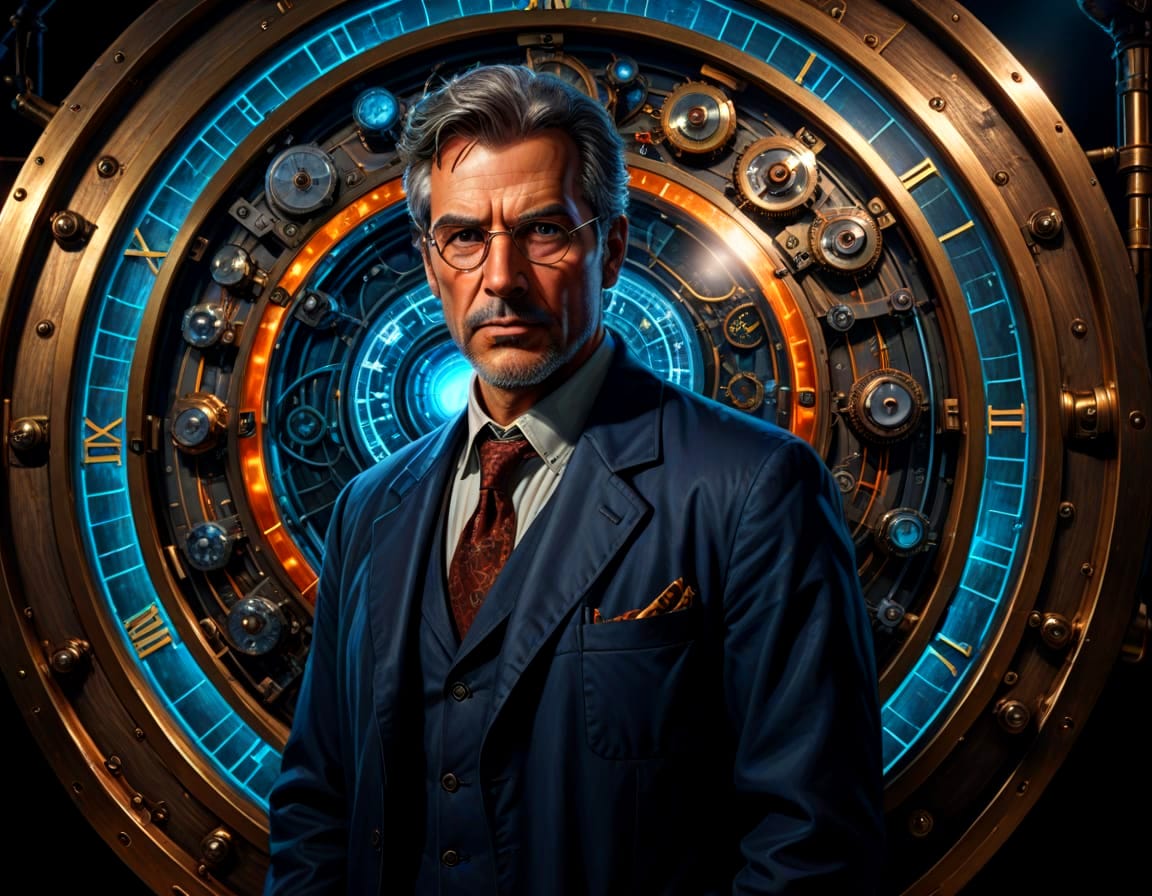
The three-mile walk through Chicago’s morning rush was a sensory assault. Every detail was marginally wrong: the color of the transit signs, the arrangement of fruit in a stand, the cadence of the traffic drone. Elias ignored the subtle shifts, focusing solely on the grid coordinates of the West Wing Laboratory.
He arrived at a sleek, modern building – all dark glass and polished steel – that housed private biomedical research. It was intimidatingly secure, guarded by a uniformed security desk and retina scanners.
Elias, still smelling faintly of plaster dust and wearing ripped silk pajamas under a stolen jacket he found in Mrs. Dalgleish’s coat closet, realized his method of entry would not be scientific. It had to be criminal.
He spent twenty minutes studying the perimeter, locating a basement delivery chute obscured by thick landscaping. It was sealed with a heavy chain and padlock.
He checked his pocket. Mrs. Dalgleish’s keys. Useless.
He pulled out the only useful tool he had: the salvaged magnet. The magnet was powerful, but not enough to disable the lock entirely. However, it was enough to trigger a brief security system disruption.
Elias wrapped the magnet in his silk scraps to muffle the sound, pressed it hard against the exterior key panel near the loading dock, and counted to ten. He heard a tiny, high-pitched whine – the brief short-circuit of a nearby sensor.
He then smashed the padlock with the base of the chisel handle he had carried. The lock burst open with a noise that felt too loud for the morning air.
He slipped inside the delivery chute just as a delivery truck turned the corner. He wrestled the chute shut, sealing himself in the stale, echoing darkness of the basement.
He was inside.
He found a stairwell and ascended two flights, reaching the laboratory access floor. He located the East Wing, then, with a tremor of anticipation, located the West Wing – the place where the current Dr. Aris Thorne worked, and where the Anchor Mass was lodged.
He reached the designated laboratory door. He knew the building’s layout. The Anchor Mass, if located within the lab, would be near the heaviest, most shielded equipment – likely a particle accelerator or a spectroscopy unit.
He didn’t bother attempting the access panel. Instead, he pulled up the university-wide internal directory on his secure tablet and searched Thorne’s contact information. He pressed the internal phone number.
It rang once.
“West Wing, Thorne,” a familiar voice answered. But this voice was colder, harder, lacking the easy warmth Elias remembered.
“Aris,” Elias said, leaning against the cold metal wall, his voice ragged. “It’s Elias Vance.”
Silence stretched across the connection, thick and heavy.
“I don’t know an Elias Vance,” Thorne’s voice replied, clinically precise. “You have the wrong line. This is a private lab.”
Elias realized the risk of this confrontation was immense. Thorne didn’t just not recognize him; this Thorne was built into a reality that had successfully erased him. He couldn’t risk a face-to-face meeting.
“Wait,” Elias said quickly. “I found a reference in a grant proposal – Project Chronoslide. I need to know about the Anchor Mass.”
The line went dead. Thorne had hung up.
Elias had confirmed the danger. Thorne knew the term. This Thorne was a scientist aware of the mechanism that had claimed Elias’s life.
A heavy, low thrumming began vibrating through the floor beneath his feet – the sound of the spectroscopy unit powering up. Thorne was either preparing to analyze the Anchor Mass, or preparing to move it.
Elias knew he had seconds. He had to breach the lab now, before the single piece of matter linking him to his true home reality vanished.